How Human Made Art Gets Mistaken for AI
At a recent indoor art fair, a young woman walked into a painter’s booth and announced, loud enough for the whole aisle to hear, that the work “has to be AI. Look how perfectly the eyes and noses are rendered. Look at those colors. Everything here screams AI.” Her embarrassed husband stood right beside her, pointing at the canvas, at the ridges of dried paint you could see from a foot away. She ignored him and kept talking.
Let’s call the painter Abigail. She has painted animals for twenty-some years, sells prints of that work for most of her income, and ran her own gallery back before any image generator existed. She spent that afternoon, and most of that weekend, telling strangers that her own hands made the thing on the wall.
The loud young woman was not a customer. Call her Jill. She was working another booth down the aisle, and she’d spent the day telling shoppers that her art was the real, human kind. Abigail only worked this out later, and she’s careful to say she has no proof Jill was aiming at her by name. But everyone walking the fair reached Jill’s corner first, arrived at Abigail’s booth already primed to squint, and asked the question Jill had planted.
The joke is that Jill sells prints too. Her table, like Abigail’s, is stacked with pictures of pictures, ink pressed onto paper by a machine. The woman policing authenticity was, herself, selling reproductions.
Is it live? Or is it Memorex?
AI art is here to stay. It’s an accepted genre now. Some of it’s good, and the people who like it aren’t fools for liking it. There’s a market, and money moves through that market whether or not we approve of the merchandise. Neither Abigail nor Jill make AI art. They may never buy it. That’s their taste, but it’s not a verdict they get to enforce at a fairground or market day.
Walk any tourist city and you’ve already wandered into that tent without noticing. In Prague you can buy a metal key fob or a fridge magnet of the Czech flag with the white and red stripes flipped, or the city’s name misspelled. That’s two different ways to buy AI slop from the same rack. The vendor doesn’t care. The tourist can’t tell. The thing sells anyway. Plenty of what a machine makes is careless junk aimed at people who won’t look closely, and the honest response to careless junk shouldn’t be panic. It’s a caveat. The people who do look closely can choose not to purchase AI slop.
A show that sells AI work beside oil paintings isn’t corrupt. It’s a bigger tent. The trouble starts only when nobody can tell which tent they’re standing in.
Ansel Adams dodged and burned
The instinct is to draw the line at manipulation, but that line crumbles the moment you look closer. Ansel Adams stood in a darkroom and dodged and burned his negatives, holding light back in one corner and pouring it on in another, to make a sky brood the way the day hadn’t quite managed. Purists of his day called it cheating. Today, we call it some of the finest photography ever made. Heavy human manipulation, done by hand, in service of a feeling, and nobody sane wants that print stamped “fake”.
Then keep going. An art print is a machine’s reproduction of a painting. Abigail’s booth runs on them. Jill’s does too. If the sin is that a machine was involved, every print table at the fair is guilty and the word stops meaning anything.
Appearance can’t be the test either. Abigail has had paintings flagged as AI by Pinterest’s own classifier, on posts she made years before AI art existed. The machine read polish and called it the fingerprint of a machine. Except polish is what a lifetime of practice produces.
What’s left, once manipulation and machinery and surface polish all fall out, is authorship. Not whose hands pressed the object, but whose mind made the image. That’s the only line that survives contact with a print table, and it’s the one worth marking.
Somebody has to draw the line
Put Adams at one end of the spectrum and that upside-down Prague flag at the other, and notice that no philosopher is going to hand you the exact point at which art or craft becomes mere generation. There’s no cosmic coordinate. There’s a decision, and it has to be made by someone with the standing to make it.
That someone is the venue. This is less strange than it sounds, because it already happens next door. Photography competitions publish what post-processing they allow and what disqualifies an entry. Sometimes it’s a straight-out-of-camera category with rules of its own. Nobody accuses those juries of solving metaphysics. They publish a threshold and enforce it. An art fair can do the same for the AI spectrum. It doesn’t need the truth of the matter. The venue needs a written standard and the nerve to hold it.
What the venue owes everyone
Abigail can help herself in the meantime. Post a small painted sign that reads Human Made, with a QR code beside it that opens a video of her actively painting. This answers the question before a stranger asks. Behind that code sits the timelapse, and a close look at the actual tubes and brushes. Anyone who has touched real paint knows the texture on sight.
But a homemade sign is self-attestation, and the Jills of the world can wave it away with a gossiped whisper. The durable fix belongs to the jury. A juried show already decides who gets to display their wares. It can grant a Human Made mark to the artists it has juried, so the claim carries the show’s word instead of one vendor’s handwriting. It can grant a Made with AI mark to the sellers who belong on the other side of the published line, openly, with no shame in it, because the buyers who want that work should be able to find it as easily as the buyers who don’t. Next? Add that to plainest rule of all: trash another exhibitor’s methods with nothing to back it, and you lose your booth this year and your invitation for the next.
A mark the show bestows upon you is worth more than one you make yourself, for the same reason a posted health-inspection grade beats a hasty scribbled note taped in the window. The jury is already doing the verifying. It might as well say so. An aisle where sellers tear each other down is an aisle where buyers trust nobody and keep their wallets shut. Protect the artists to protect the gate.
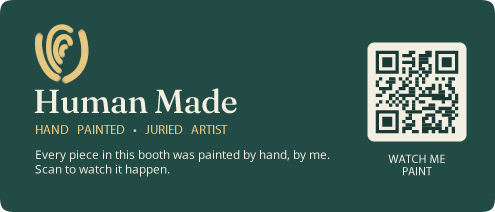
The payoff
Pin a Human Made mark to Abigail’s booth and Jill’s whisper has nowhere to land. The doubt she was selling gets answered by the show itself, before she opens her mouth, and the shoppers who prefer a machine’s work walk down to the booth that honestly says so. Everyone sells to the people who actually want what they make. Nobody has to lie, and nobody has to defend a lifetime of practice against a stranger’s shrug.
Abigail spent twenty years learning to paint animals that never quite existed, their eyes lit from somewhere behind the canvas, their colors found on no living creature. That glow is the very thing a stranger points at and calls “AI”. But the image models learned to paint by swallowing millions of pictures scraped off the open web, and work like hers was in the pile. If anyone in that booth copied anyone, the machine copied her, years after she did the physical work, and not the other way around. The accusation runs backward. Abigail stands charged with imitating her own reflection.
The worst-behaved person in this story was the one leveling the charge. The one who kept her composure (Abigail), and never once threw it back, was the one being accused. Whatever the fairs decide, that’s what needs to be protected.
Abigail Childress – Painter
My work is human made. Every piece here was painted by hand, by me, Abigail, with over 20 years of practice. Every color print is scanned precisely from my hand-painted work.
I don’t use AI to generate my images. If something looks “too perfect,” that’s the skill I’ve spent two decades building. You can watch me build it. The code on my sign links to timelapse videos of these exact paintings, and I’m always glad to walk you through my process and my materials in person.
I celebrate every artist working by hand. I stand proudly behind my work.
Another example of wording that could help establish your credibility. (Abigail Childress does not exist and is used here as an example.)
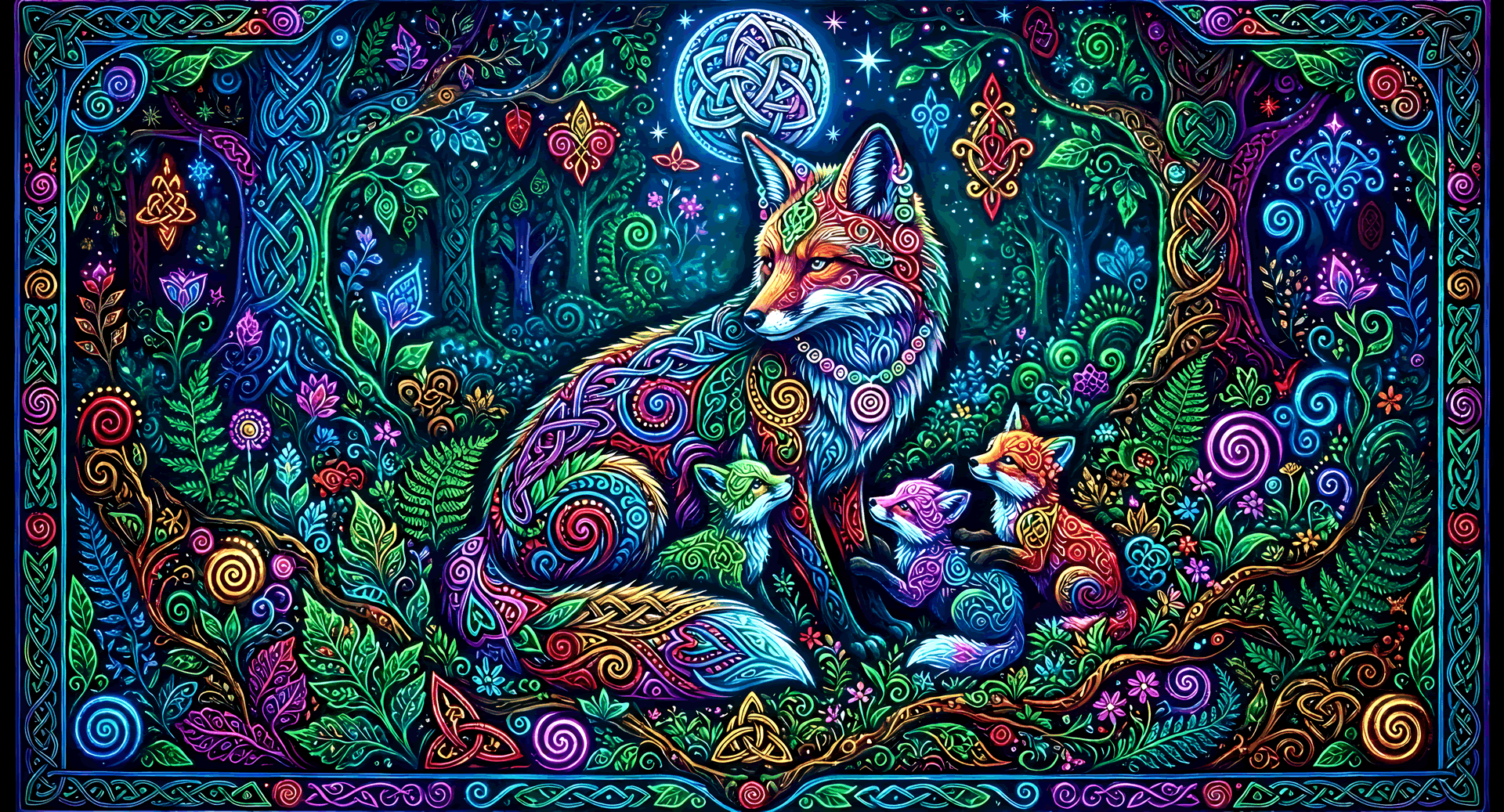
Full Disclosure: The featured image was created by me using AI as an example of AI art. It took me all of a few minutes to spin up a prompt. It’s not meant to convince you that AI is good or bad. It simply is.